RAG Any Docs with Fused
TL;DR: With a few Fused UDFs you can turn any public docs site into a fully searchable RAG pipeline — connect data, process it, and expose it as an API.
This example shows how to build a RAG pipeline over Overture Maps documentation using Fused — from ingestion to a queryable API endpoint. The same pattern works for any public docs site.
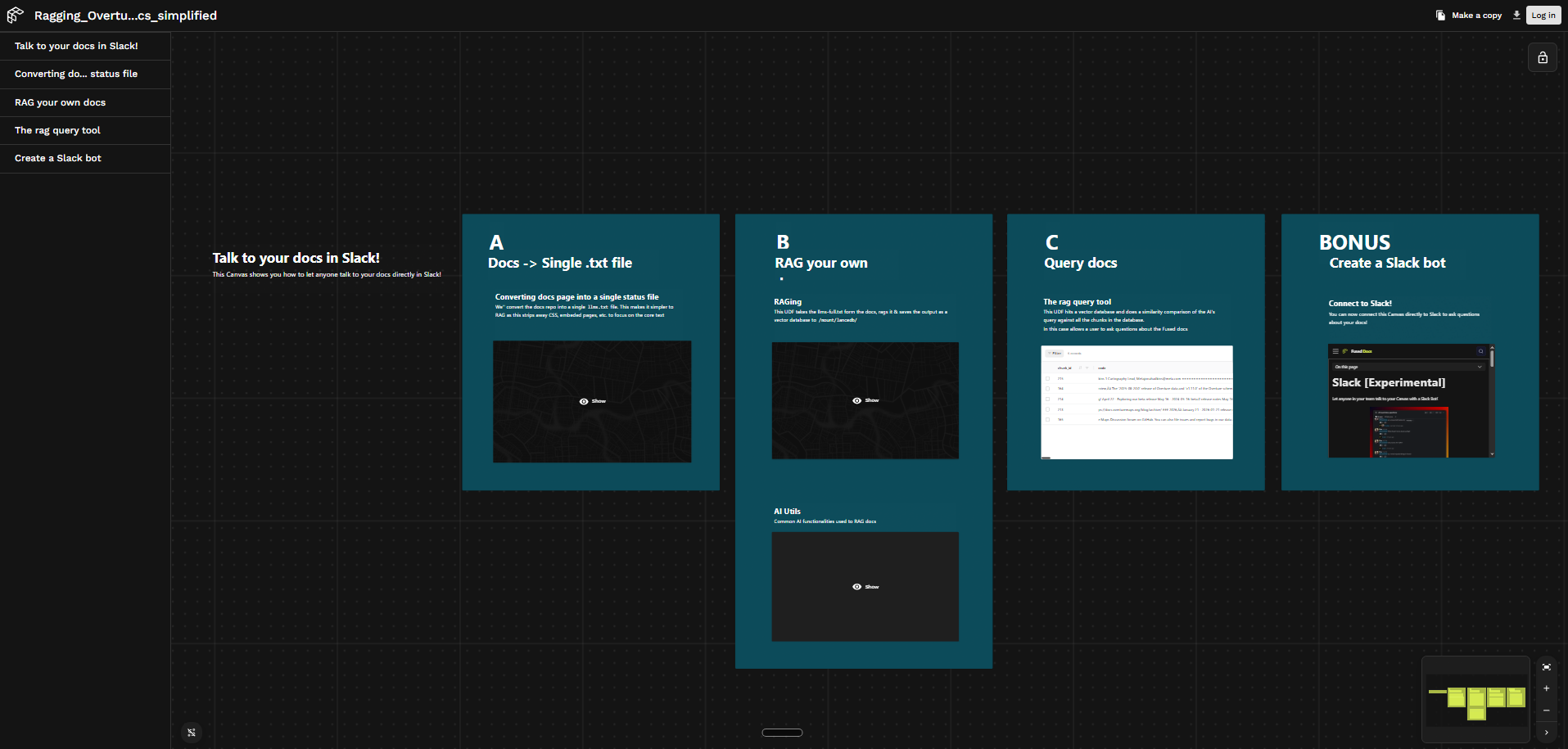
How it works
The pipeline follows a crawl → embed → search pattern, implemented as four UDFs:
site_to_llmstxt— crawls any docs site via its sitemap and writes a cleanllms.txtto S3docs_ragging— embeds thellms.txtin chunks and stores vectors in a LanceDB table at/mount/lancedb/overture_docs_searching— searches by embedding an incoming question and returning the most relevant chunksai_utils— shared helpers for embedding, LanceDB reads/writes, and agentic tool calling
Step 1: Crawl Any Docs Site into llms.txt
The first challenge is getting clean text out of a docs site. HTML is noisy: navbars, footers, sidebars, and scripts all get in the way. The site_to_llmstxt UDF accepts any docs site URL, crawls every page in parallel via crawl_page.map(), strips boilerplate, and writes a single clean llms.txt to S3.
Show site_to_llmstxt UDF code
@fused.udf(cache_max_age='1d')  # Caching for 1d to prevent accidental reruns
def udf(
    base_url: str = "https://docs.overturemaps.org/",
    site_name: str = "Overture_maps_documentation",
    mode: str = "full",  # "curated" | "full"
    sitemap_path: str = "/sitemap.xml",
    max_pages: int = 0,  # 0 = no limit, useful for testing
    output_dir: str = "s3://fused-asset/demos/llms_txt/",
):
    """Generate an llms.txt from any public docs site with a sitemap."""
    import re
    import time
    import requests
    import pandas as pd
    from xml.etree import ElementTree
    from bs4 import BeautifulSoup

    def fetch(url: str, retries: int = 3, timeout: int = 15) -> str | None:
        headers = {"User-Agent": "llms-txt-generator/1.0 (sitemap crawler)"}
        for attempt in range(retries):
            try:
                r = requests.get(url, headers=headers, timeout=timeout)
                r.raise_for_status()
                return r.text
            except Exception as e:
                if attempt == retries - 1:
                    print(f"  ✗ Failed {url}: {e}")
                    return None
                time.sleep(1.5 ** attempt)

    def parse_sitemap(xml_text: str) -> list[str]:
        """Parse a sitemap or sitemap index and return all page URLs."""
        try:
            root = ElementTree.fromstring(xml_text)
        except ElementTree.ParseError:
            return []
        ns = {"sm": "http://www.sitemaps.org/schemas/sitemap/0.9"}
        urls = []
        for sitemap_tag in root.findall("sm:sitemap", ns):
            loc = sitemap_tag.find("sm:loc", ns)
            if loc is not None and loc.text:
                sub_xml = fetch(loc.text.strip())
                if sub_xml:
                    urls.extend(parse_sitemap(sub_xml))
        for url_tag in root.findall("sm:url", ns):
            loc = url_tag.find("sm:loc", ns)
            if loc is not None and loc.text:
                urls.append(loc.text.strip())
        return urls

    sitemap_url = base_url.rstrip("/") + sitemap_path
    print(f"Fetching sitemap: {sitemap_url}")
    sitemap_xml = fetch(sitemap_url)
    if not sitemap_xml:
        raise RuntimeError(f"Could not fetch sitemap at {sitemap_url}")

    all_urls = parse_sitemap(sitemap_xml)
    print(f"Found {len(all_urls)} URLs in sitemap")

    skip_patterns = re.compile(
        r"/(tags?|search|404|sitemap|assets|_|static)/|"
        r"\.(xml|json|txt|png|jpg|svg|css|js)$",
        re.IGNORECASE,
    )
    page_urls = [u for u in all_urls if not skip_patterns.search(u)]
    page_urls = sorted(set(page_urls))

    if max_pages > 0:
        page_urls = page_urls[:max_pages]

    print(f"Processing {len(page_urls)} doc pages (mode={mode})")

    print(f"Crawling {len(page_urls)} pages in parallel...")
    results = crawl_page.map(
        [{"url": u} for u in page_urls],
        engine="local",
        max_workers=10,
    ).df()

    pages = results.to_dict("records")
    print(f"Successfully extracted {len(pages)} pages")

    header = f"# {site_name}\n\n"

    if mode == "curated":
        lines = [header, "## Pages\n"]
        for p in pages:
            lines.append(f"- [{p['title']}]({p['url']})")
        lines.append(f"\n---\n\nGenerated from {base_url} sitemap. Total pages: {len(pages)}")
        output = "\n".join(lines)
    else:
        sep = "=" * 80
        sections = [header, sep + "\n"]
        for p in pages:
            sections.append(f"## {p['title']}")
            sections.append(f"URL: {p['url']}\n")
            if p["content"]:
                sections.append(p["content"])
            sections.append("\n" + sep + "\n")
        sections.append(f"\n---\n\nGenerated from {base_url} sitemap. Total pages: {len(pages)}")
        output = "\n".join(sections)

    if output_dir:
        import fsspec
        safe_name = re.sub(r"[^\w]+", "_", site_name.lower()).strip("_")
        output_path = output_dir.rstrip("/") + f"/{safe_name}/llms.txt"
        with fsspec.open(output_path, "w") as f:
            f.write(output)
        print(f"Written to {output_path}")
        return output_path
    else:
        return output


@fused.udf
def crawl_page(url: str = "https://docs.overturemaps.org/"):
    """Fetch and extract content from a single docs page. Used by udf.map()."""
    import re
    import time
    import requests
    from bs4 import BeautifulSoup

    headers = {"User-Agent": "llms-txt-generator/1.0 (sitemap crawler)"}
    for attempt in range(3):
        try:
            r = requests.get(url, headers=headers, timeout=15)
            r.raise_for_status()
            html = r.text
            break
        except Exception:
            if attempt == 2:
                return None
            time.sleep(1.5 ** attempt)
    else:
        return None

    soup = BeautifulSoup(html, "html.parser")
    for tag in soup.select(
        "nav, footer, aside, .sidebar, .toc, .table-of-contents, "
        ".navbar, .pagination, .edit-this-page, script, style, "
        "[class*='sidebar'], [class*='navbar'], [class*='footer'], "
        "[class*='toc'], [class*='pagination'], [class*='breadcrumb'], "
        "[aria-hidden='true']"
    ):
        tag.decompose()

    title = ""
    h1 = soup.find("h1")
    if h1:
        title = h1.get_text(strip=True)
    if not title:
        title_tag = soup.find("title")
        if title_tag:
            title = re.sub(r"\s*[|–—-].*$", "", title_tag.get_text(strip=True))

    content_el = (
        soup.find("article")
        or soup.find(class_=re.compile(r"md-content|markdown|content|documentation"))
        or soup.find("main")
        or soup.body
    )

    if content_el is None:
        import pandas as pd
        return pd.DataFrame([{"url": url, "title": title, "description": "", "content": ""}])

    def extract_content(el) -> str:
        from bs4 import NavigableString, Tag

        BLOCK_TAGS = {"p", "div", "section", "li", "dt", "dd", "blockquote",
                      "h1", "h2", "h3", "h4", "h5", "h6", "tr", "thead", "tbody"}

        def walk(node) -> str:
            if isinstance(node, NavigableString):
                return str(node)
            if not isinstance(node, Tag):
                return ""
            tag = node.name.lower() if node.name else ""
            if tag == "pre":
                inner_code = node.find("code")
                lang = ""
                if inner_code and inner_code.get("class"):
                    for cls in inner_code.get("class", []):
                        m = re.match(r"language-(\w+)", cls)
                        if m:
                            lang = m.group(1)
                            break
                code_text = (inner_code or node).get_text()
                return f"\n\n```{lang}\n{code_text.strip()}\n```\n\n"
            if tag == "code":
                text = node.get_text()
                if "\n" in text:
                    return f"\n\n```\n{text.strip()}\n```\n\n"
                return f"`{text}`"
            if tag in {"h1", "h2", "h3", "h4", "h5", "h6"}:
                level = int(tag[1])
                return f"\n\n{'#' * level} {node.get_text(strip=True)}\n\n"
            parts = [walk(child) for child in node.children]
            text = "".join(parts)
            if tag in BLOCK_TAGS:
                text = text.strip()
                return f"\n\n{text}\n\n" if text else ""
            return text

        raw = walk(el)
        return re.sub(r"\n{3,}", "\n\n", raw).strip()

    content = extract_content(content_el)

    description = ""
    for line in content.splitlines():
        line = line.strip()
        if len(line) >= 40 and not line.startswith("#") and not line.startswith("`"):
            description = line[:160] + ("..." if len(line) > 160 else "")
            break

    import pandas as pd
    return pd.DataFrame([{"url": url, "title": title, "description": description, "content": content}])
Step 2: Chunk, Embed, and Store in LanceDB
The docs_ragging UDF fetches the llms.txt from S3, splits it into overlapping chunks, embeds each chunk using the Qwen3-Embedding-8B model via OpenRouter, and writes the result to a LanceDB table on the shared volume at /mount/lancedb/.
Show docs_ragging UDF code
# ===================== CONFIGURATION =====================
LANCEDB_TABLE_NAME = "overture_docs_17_04_2026"
LANCEDB_BASE_PATH = "/mount/lancedb/"
EMBEDDING_MODEL = "qwen/qwen3-embedding-8b"
SOURCE_S3_PATH = "s3://fused-asset/demos/llms_txt/overture_maps_documentation/llms.txt"
CHUNK_SIZE = 1300
OVERLAP_PERCENT = 0.15
OVERLAP_SIZE = int(CHUNK_SIZE * OVERLAP_PERCENT)
EMBEDDING_BATCH_SIZE = 400
# =========================================================


@fused.udf(cache_max_age=0)
def udf(
    table_name: str = LANCEDB_TABLE_NAME,
    overwrite: bool = True,
):
    import pandas as pd
    import fsspec

    ai = fused.load("ai_utils")

    print(f"Fetching docs from: {SOURCE_S3_PATH}")
    with fsspec.open(SOURCE_S3_PATH, "r") as f:
        content = f.read()
    print(f"Fetched {len(content):,} characters")

    chunks = chunk_with_overlap(content, CHUNK_SIZE, OVERLAP_SIZE)
    print(f"Created {len(chunks)} chunks")

    df = pd.DataFrame(
        {
            "chunk_id": list(range(1, len(chunks) + 1)),
            "code": chunks,
            "source_url": SOURCE_S3_PATH,
        }
    )

    print("Embedding chunks via ai_utils.embed_df...")
    df = ai.embed_df(
        df,
        text_col="code",
        embedding_col="embedding",
        provider="qwen",
        embedding_model=EMBEDDING_MODEL,
        batch_size=EMBEDDING_BATCH_SIZE,
        max_workers=16,
    )

    print(f"Writing {len(df)} rows to LanceDB table: {table_name} at {LANCEDB_BASE_PATH}")
    table_path = ai.write_table(
        df,
        table_name=table_name,
        embedding_col="embedding",
        base_path=LANCEDB_BASE_PATH,
        overwrite=overwrite,
    )

    visible_tables = ai.list_tables(base_path=LANCEDB_BASE_PATH)
    table_exists_now = ai.table_exists(table_name, base_path=LANCEDB_BASE_PATH)

    return pd.DataFrame(
        {
            "status": ["success"],
            "table_name": [table_name],
            "table_path": [table_path],
            "lancedb_base_path": [LANCEDB_BASE_PATH],
            "table_exists_after_write": [table_exists_now],
            "source_url": [SOURCE_S3_PATH],
            "content_chars": [len(content)],
            "chunks": [len(chunks)],
            "chunk_size": [CHUNK_SIZE],
            "overlap_size": [OVERLAP_SIZE],
        }
    )


def chunk_with_overlap(text, chunk_size, overlap_size):
    """Split text into chunks with fixed overlap."""
    chunks = []
    start = 0
    text_length = len(text)

    while start < text_length:
        end = start + chunk_size
        chunk = text[start:end]
        chunks.append(chunk)
        start = end - overlap_size
        if start + chunk_size >= text_length and start < text_length:
            final_chunk = text[start:]
            if final_chunk and final_chunk not in chunks and len(final_chunk) > overlap_size:
                chunks.append(final_chunk)
            break

    return chunks
After running, the UDF returns a status table:
status   table_name                 table_path                              chunks  chunk_size  overlap_size  content_chars
success  overture_docs_17_04_2026   /mount/lancedb/overture_docs_17_04_2026  639     1300        195           706121
Embeddings are generated in batches of 400 chunks with up to 16 concurrent workers. Switching to a different embedding model is a one-line change in the EMBEDDING_MODEL constant at the top of the UDF.
Step 3: Semantic Search as a Fused API
The overture_docs_searching UDF accepts a natural-language question, embeds it with the same model, and runs a cosine similarity search against the stored chunks in LanceDB. Because it's a standard Fused UDF, it's immediately available as an HTTP endpoint.
Show overture_docs_searching UDF code
@fused.udf
def udf(
    question: str = "Latest release?",
):
    """Searches Overture docs RAG for matching areas in the documentation."""
    import pandas as pd

    collection_name = "overture_docs_17_04_2026"
    limit = 30
    base_path = "/mount/lancedb/"

    ai = fused.load("ai_utils")

    if not ai.table_exists(collection_name, base_path=base_path):
        available = ai.list_tables(base_path=base_path)
        return pd.DataFrame(
            {
                "status": ["error"],
                "error": [f"LanceDB table '{collection_name}' was not found."],
                "base_path": [base_path],
                "available_tables": [", ".join(available) if available else "(none)"],
            }
        )

    df = ai.search(question, collection_name, top_k=limit)

    if df is None or len(df) == 0:
        return pd.DataFrame({"status": ["empty"], "message": ["No vector matches found."]})

    cols_to_drop = [c for c in ["_distance", "_relevance_score", "vector", "embedding"] if c in df.columns]
    if cols_to_drop:
        df = df.drop(columns=cols_to_drop)

    return df.head(5)
Asking "Latest release?" returns a ranked table of the most relevant doc chunks:
chunk_id   similarity   code
215        0.123        ## Overture Maps Engineering Blog ... August 20, 2025 — 2025-08-20.0 release ...
164        0.112        The 2025-08-20.0 release of Overture data and v1.11.0 of the schema are now available ...
214        0.095        April 22 - Exploring our beta release / May 16 - 2024-05-16-beta.0 release notes ...
213        0.092        ### 2026 — January 21 - 2026-01-21 release notes / February 11 - Overture Has ...
165        0.092        The base, buildings, divisions, places, and transportation themes are in GA ...
Each search request re-embeds the question on every call. Wrap the UDF with @fused.cache to cache results for repeated or identical queries and cut latency significantly.
Using This for Any Site
To RAG a different docs site, update these values:
- In
site_to_llmstxt, updatebase_urlon line 2 of the UDF parameters:
base_url: str = "https://docs.myproject.io/", # URL of the docs site to crawl
- In
docs_ragging, update the two constants at the top of the file:
SOURCE_S3_PATH = "s3://your-bucket/myproject/llms.txt"  # S3 path where site_to_llmstxt wrote the output
LANCEDB_TABLE_NAME = "myproject_docs_v1"                # unique name for this project's vector table
- In
overture_docs_searching, updatecollection_nameto match:
collection_name = "myproject_docs_v1" # must match LANCEDB_TABLE_NAME above
- Large document sets may take time to index — crawling and embedding hundreds of pages runs in parallel but is still I/O and compute-bound
- Re-indexing overwrites the existing LanceDB table and re-embeds all chunks, which incurs additional embedding API costs; only re-index when the source docs change significantly
Connect to Slack
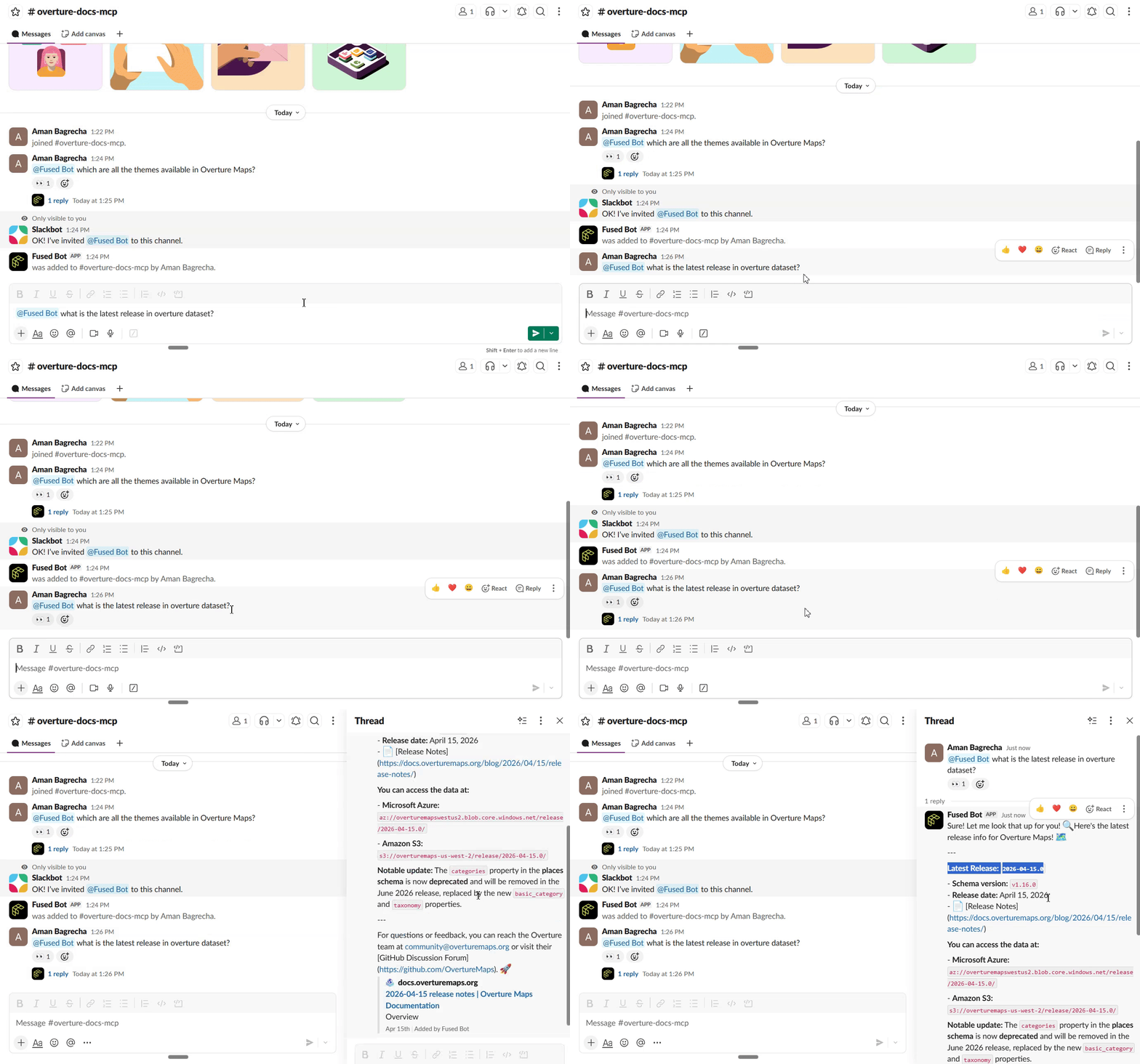
Once the search UDF is live as a Fused API endpoint, you can connect it to Slack so your team can query the docs directly from a channel. The Fused Slack integration lets you wire any UDF endpoint to a Slack bot — no extra infrastructure needed.
Next Steps
To go further with this pipeline, explore these pages:
- Caching — cache embedding and search results to avoid recomputing on repeated queries
- UDFs as API — expose any UDF as an HTTP endpoint with a shared token
- Slack integration — route search queries through a Slack bot
- Building for Agents — use UDF endpoints as tools in an agentic workflow
Try the full pipeline on Fused Canvas to see all four UDFs wired together.