How to run a batch job
Batch jobs run on dedicated machines with more resources and no time limits. Use them when your UDF needs more than realtime can offer.
This guide covers best practices for batch workflows—when to use them, how to get results, and how to monitor jobs.
When to use batch
Use batch when your UDF exceeds realtime limits:
- Takes longer than 120s to run
- Needs more than ~4GB RAM
Tradeoffs:
- ~30s startup time (machine needs to spin up)
- Higher resource availability
Starting a batch job
Add instance_type to run on a dedicated machine:
@fused.udf(instance_type='small')
def udf():
    # This UDF runs on a batch instance
    ...
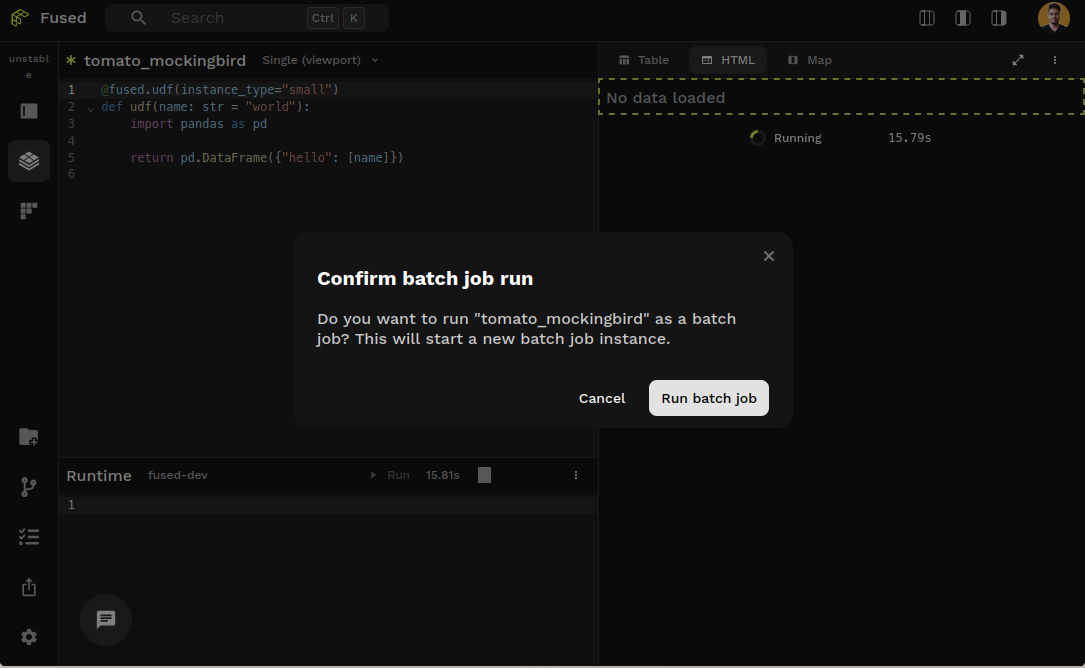
In Workbench, batch UDFs require manual execution (Shift+Enter) and show a confirmation modal.
Batch and realtime jobs have separate caches. Running the same UDF with and without instance_type will cache results independently.
Best practices
Write to disk, don't return data
Batch jobs should write results to cloud storage or mount, not return them. Data returned from batch jobs can be lost if the connection times out.
@fused.udf(instance_type='small')
def batch_job(input_path: str):
    import pandas as pd

    # Process data
    df = pd.read_parquet(input_path)
    result = heavy_processing(df)

    # Write to S3, not return
    output_path = f"s3://my-bucket/results/{...}"
    result.to_parquet(output_path)

    return output_path  # Return the path, not the data
Monitor your jobs
Batch jobs take time to start and run. Use the Jobs page in Workbench to monitor:
- Status: Running, Completed, Failed
- CPU & Memory: Resource usage over time
- Disk: Storage consumption
- Runtime: How long the job has been running
- Logs: Real-time output from your UDF
# Programmatic monitoring
job.status          # Check status
job.tail_logs()     # Stream logs
job.cancel()        # Stop a job
Expect startup delay
Batch machines take ~30s to spin up. Plan accordingly—batch jobs aren't for quick iterations.
Test your UDF on a small data sample using realtime execution. Once you're confident it works, switch to instance_type to scale up.
Instance types
| Alias | vCPUs | RAM |
|---|---|---|
small | 2 | 2 GB |
medium | 16 | 64 GB |
large | 64 | 512 GB |
See Run UDFs in python for the full list of AWS/GCP instance types.
Example use cases
- Ingesting cropland data for zonal statistics
- Data ingestion for large geospatial files
See also
- Run UDFs in python —
instance_typereference - Run UDFs in parallel —
fused.submit()with batch instances - Caching — how caching works